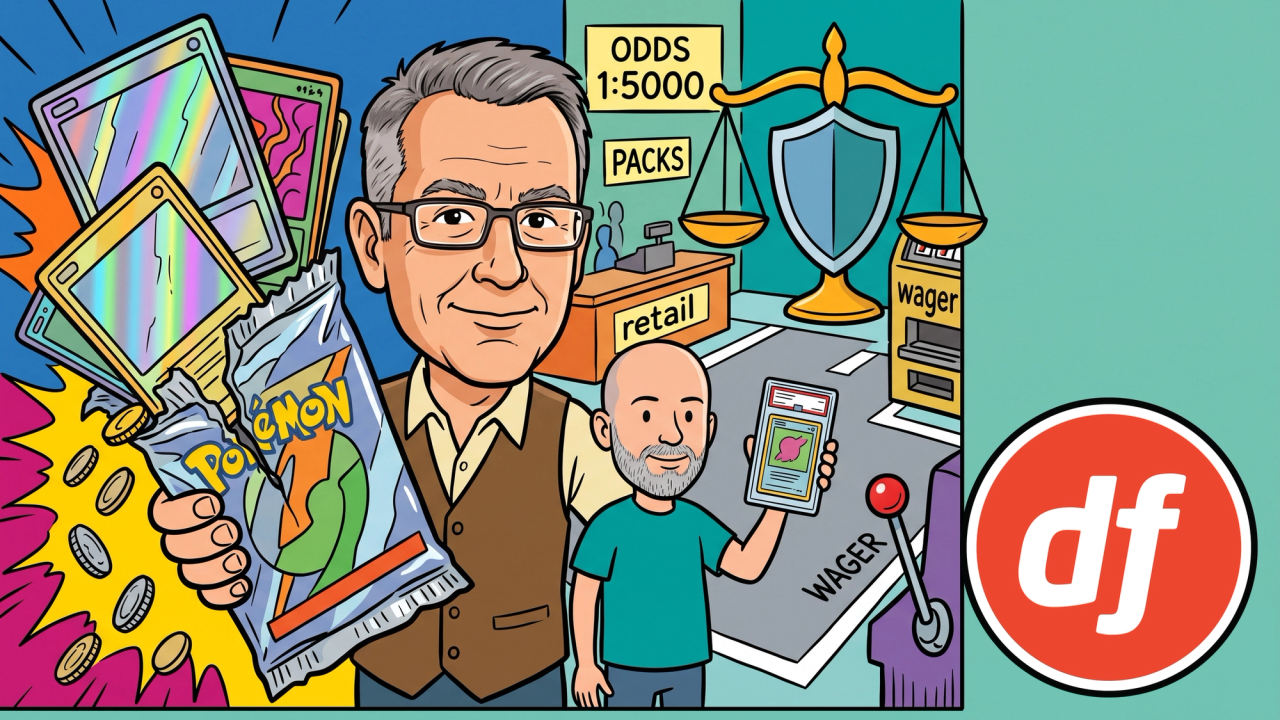
A new class of product is blurring the line between collectibles retail and gambling, and regulators have not caught up with it. CrownCards is a clean example. It is a mobile app where you buy a digital pack, open it, and receive a real, professionally graded trading card, either a Pokémon or a sports card, authenticated and sealed in a slab. You can keep it in a vault, have it shipped, or sell it back. On the surface it is an e-commerce retailer. Look closer and it has the mechanics of a lottery: randomised outcomes, tiered rarity, and a cash-out at the end.
This matters to any operator working near the gambling line, because the argument CrownCards relies on is the same argument being tested across loot boxes, prize draws and sweepstakes. Understanding where it sits tells you where regulation is heading next, and where the risk is for anyone copying the model.
What the product actually is
CrownCards is operated by Crown Cards LLC, a US company registered in Cheyenne, Wyoming, and describes itself as "a retailer of graded trading card collectibles." The mechanics are consistent across its own site:
That combination of pay money, get a random outcome, and convert the outcome back to money is the core loop every gambling regulator recognises. The packaging is retail. The loop is a wager.
Where it sits against gambling law
Most gambling regulation tests three things together: consideration (you pay to play), chance (the outcome is random), and prize (you receive something of value). Some jurisdictions add a fourth filter, asking whether the participant can influence the outcome through skill.
CrownCards satisfies consideration and chance plainly. The interesting question is prize, and that is where the model is engineered carefully. The defence runs like this:
The weakness sits in the same place. A buyback offer at 100% of fair market value, available on demand, turns the card into an instrument you can convert back to cash. Once the participant can reliably exit to money, the "it is just a collectible" line gets much thinner. Regulators increasingly look at substance over labelling, and the substance here is a randomised product with a guaranteed exit to cash.
It is worth being precise about what the fourth filter, skill, does and does not save. In some jurisdictions a product escapes gambling classification if the participant can influence the outcome, which is why fantasy sports and skill-contest products fight so hard on that point. Pack opening offers no such escape. The buyer cannot influence which card appears. There is no draft, no trade decision, no play to make. The only skill in the loop happens after the random event, when the buyer decides whether to hold, ship or sell. That is portfolio management, not gameplay, and no regulator treats it as influencing the draw.
CrownCards versus loot boxes
Loot boxes are the closest structural cousin. In both cases you pay, you open, and you receive a randomised item. The regulatory fight over loot boxes has largely turned on two things: whether the contents can be cashed out, and whether the product targets minors.
CrownCards is stronger than a typical loot box on both counts. Its items hold genuine independent market value, and it has invested in authentication, grading and physical delivery, none of which the loot box has. CrownCards is weaker on the cash-out question, because it *actively offers* the buyback that turns the item into money, where most loot boxes pay out only in in-game items. The irony is that the feature which makes CrownCards more legitimate as a collectible business is the same feature that makes it look more like gambling.
CrownCards versus prize draws and competitions
Prize draw sites are the other neighbour. They sell paid entries into a random draw for a high-value prize, and they defend on the basis that the prize is a physical good and the draw is a promotion, not betting.
CrownCards differs in an important way. A prize draw has one end state: win the prize or do not. CrownCards has a *continuing market*: the card can be valued, kept, shipped or sold back, and the platform is a participant in that market through the buyback. That makes it less like a one-off competition and more like a repeated-play product. Repeated play with a cash exit is precisely the pattern that triggers gambling licensing rather than consumer-promotion rules.
The tiering matters too. A prize draw usually sells one entry at one price for one prize. CrownCards sells a ladder of packs from $25 to $1,000, with the higher tiers priced well beyond what the underlying cards would cost at retail. That structure is familiar from another neighbour: the coin purchase ladders of social casino and sweepstakes casino products, where the price of the bundle rises faster than the value of what it contains. Regulators have already started applying gambling-style scrutiny to those products in several US states, and the pack ladder reads the same way: the premium is not for the goods, it is for the chance.
Why this matters for operators
The CrownCards model is attractive and it is being copied. If you operate anywhere in collectibles, prize draws, sweepstakes or adjacent products, the pressure points are predictable:
None of this means the model is unlawful. It means the model lives in the grey zone, and grey zones have a habit of closing. The operators that anticipate the question, and build the licensing, compliance and disclosure posture before they are asked, are the ones who keep the business when the line moves.
The wider pattern
CrownCards is a useful case because it is so clearly built. Every element that makes it feel legitimate (real cards, professional grading, physical shipping) and every element that makes it feel like gambling (paid packs, random odds, guaranteed buyback) is deliberate. That is what the modern grey zone looks like. It is not a shadowy offshore sportsbook. It is a well-designed consumer app with a payment loop that happens to tick the boxes of a wager.
Regulators are moving toward substance-based tests across loot boxes, prize draws and prediction markets. The operators that treat that shift as a design constraint rather than an obstacle will be the ones still trading when the rules catch up with the product.
Our verdict
This is a genuinely good product. It is well built, the odds are disclosed before you buy, and what you pull is a real, graded item rather than a picture on a screen. Nothing here looks unlawful, and it is a cleaner citizen than most of the models we see in the grey zone. But it leaves the one question that did the most damage to loot boxes sitting in the open, and it should answer it before a regulator, or a parent, does.
How old is the buyer, and where did the money come from to buy that many packs?
That is the whole issue. A product like this can be opened by someone with no income of their own and, once they are hooked, the spend does not stop at $25. There is a $10,000 pack on the shelf. In the worst cases we have seen around loot boxes, that money has been a parent's, taken without permission, or a debt in a child's name that the family discovers months later. The card at the end is real. The harm behind it is just as real when the buyer should never have been able to fund the account.
So we went and read the paperwork. Here is what CrownCards actually promises, and where the promise stops early.
What the terms say. The Terms of Use are explicit that you must be at least 18, or the age of majority in your jurisdiction, whichever is greater. To be an "Eligible User" you must also have completed CrownCards' registration and identity verification, and its "KYC Verification" is defined broadly. It covers identity, age, account, payment, tax, sanctions, source-of-funds and location checks, and it can include a live selfie, government ID, proof of address and a taxpayer number. There is also a dedicated AML/KYC and OFAC policy referenced in the terms. On paper, this is a real compliance programme, not a fig leaf.
Where it stops early. The timing is the weak point. Buying and opening packs does not obviously sit behind KYC. The documents put the verification gates at the cash-out and at shipping: KYC is required before an item is shipped, before a Sale Proceeds Request, and before bonus or promotional credit is used. CrownCards also reserves the right to verify you at any time, so it can pull the gate forward. But as written, a new account can fund a balance and open packs before its identity or its source of funds has been checked. Source-of-funds review appears in the KYC definition and in the list of reasons a payout can be delayed, rather than as a condition of spending in the first place.
What the privacy policy admits. It repeats the 18-plus rule for buying and selling, and says it does not knowingly collect data from children under 13. Then it tells you what to do if a minor under 18 gets into the transaction features. That line only makes sense if the company knows the age gate is not airtight. It also confirms the platform collects government ID images and facial video, which is sensitive biometric data, and it restricts that data to verification and fraud checks.
What we would tell them. Front-load the gate. Verify age and run a source-of-funds signal before an account can spend repeatedly, not only when it tries to take money out, because by then the money has changed hands. Put a hard velocity and spend ceiling on unverified accounts. Publish the KYC and source-of-funds policy as a plain customer-facing page rather than burying it in definitions. And put the age question on the marketing, not just in clause 3, because the parents who find out too late are the ones who set the tone for the whole category.
None of this makes CrownCards the villain. It makes it the test case. The operators that answer the age and money questions early will keep the business when the line moves, and the ones that wait will spend their first year of regulation explaining why they did not.
If you are building or scaling a product that sits near the gambling line, whether collectibles, prize draws, sweepstakes or prediction markets, the time to get the licensing and compliance posture right is before a regulator asks. Explore our Digital Fuel services or contact the team to talk it through.
Ready to put this into practice?
Get in touch